Friday, October 10, 2008

Dragons, Costumes, and an aside on Rice Crispie Treats

Collegio Yeccan Waldorf students put on a San Micael play where Jorge defeated the dragon in a perfect stone grotto at a park in the hills above Guanajuato.  Costumed first through eighth graders played the threatened farmers, the king and his court (including Noah as one of the guards), and of course the dragon (Dana was one of four fifth graders in the dragon costume).  The kids variously sang and spoke the story to recorder accompaniment - all in Spanish, of course.  It was a great show.

Afterwards, we participated in an intercambio, an exchange of homemade goods as a celebration of the fall harvest.  Our rice crispie treats were not very indicative of autumn, but were certainly a hit.  Regular rice crisp cereal wasn't in the store this week, so we made them with cocoa rice crisp cereal ("Arroz Inflado Sabor Chocolate" the box says, for those interested in the Spanish). Marshmallows here come with various colors in one bag, so there was some debate about whether to use both the strawberry and vanilla marshmallows with the chocolate cereal, creating a neapolitan sort of dessert.  We ended up sorting out the pink marshmallows this time, but Dana's classmates (yes, we've already corrupted them, she has shared at lunch) are familiar with rice crispie treats in several variations.
That's Dana's class taking their post-play bow, with friends Maura and Danae on the left and Dana on the right in the dragon.  The dragoneers moved well together, with one little kid yelling out as they approached, "Will it breathe fire and eat children?"

Our first experience seeing a costumed event however, was when Noah and I hiked through the mountain village of al Mineral del Monte de San Nicolas during a religious festival.  The parade included some fifty people on horseback, like the woman in the photo.  No dragon, but a noisy event with church bells ringing, fireworks going off, and drums and brass instruments playing.

Then there was the weekend we were in San Miguel de Allende, about an hour from Guanajuato, and wandered past costumed dancers with huge headdresses.  Also on that trip, we were in the village of Atotonilco, site of the church where Father Hidalgo led the revolutionaries after his September 16, 1810 speech, and picked up the banner of the Virgin of
 Guadalupe for the group to march under.  The market there was very focused on religious items, such as crosses, rosaries, "Pope trading cards" as Noah said, saint medals, and even latigos for self-flagellation.  The part I liked best was watching the Purepecha women from the countryside.  I practiced taking photos holding the camera down by my side instead of up to my face, so as to be less intrusive.

All these costumes and we're not even to Halloween and Dios de los Muertos yet.  We hear the kids' school assigns a category of costume to each class.  Dana thinks the fifth graders are supposed to be vegetables.  Ah, so much to look forward to.


Thursday, October 2, 2008

Learning from Salsa

I knew I would be eating salsa in Mexico, but I hadn't expected to be dancing salsa.  Then we discovered the trimester program for Tom and I includes two extra cultural classes a week, and while Tom is eagerly anticipating cooking, it is salsa dance class right now.  On week four, we're into more complicated steps, occasionally at hyper-speed, depending on the song our teacher selects. I tell Tom to think of it as just a series of moves, like the football plays of his high school years.  And that it's good for him that an activity is easier for me than him, for once.

Maestro Herardo (or Suave to his friends) is an amazing dancer and teacher, with a quick sense of humor.  And don't he and Ester from Norway look good together in the photo? He has reinforced our directional vocabulary as he calls out in Spanish to turn left or right, and as he directs us in the warm-ups before class ("arriba, abajo, arriba, abajo, " as we're to look up and down to warm up our neck and head).  When we went to buy Dana a shoulder bag for school, Tom could describe what we were looking for because he learned the word for shoulder from dance class.

I can hum a few of the salsa tunes now, because we have the cd of the ones used in class.  We also listen to the University of Guanajuato radio station in the apartment, and of course they sometimes play salsa.  The U of Guanajuato station is also like student stations everywhere - it has classical shows and quite a few eclectic time slots where you might hear Mexican heavy metal and then a Spanish folk song.  In other eclectic music notes, Tom got the scoop on Mexican ska from some local folks and has a list of bands to purchase, we heard a five-piece Dixieland group and went to the symphony (they had a super dramatic guest conductor that the kids loved, and Smetner's Ciclo was very engaging), plus there is always street music here.  Now we wish we had our saxes and some of Tom's drums with us.

While we're in salsa class on the terrace at Escuela Mexicana for an hour in the evening a couple times a week, the kids are on site in a classroom trading off reading and using the computer.  Though they have been invited, they haven't ventured onto the dance class with us.  They would do great if they were up for dancing with the adults, such as dance and Spanish classmates Esther and Andrea from New Zealand, with me after class in the photo.  Esther says dancing salsa is not of her culture.  We joke that she is getting in touch with her inner Latina.

The next jump in our salsa education would be to go out to one of the dance clubs and practice our moves.  Tom and  I haven't yet, but we'll have to get brave (and a babysitter) at some point.  New moves and learning from salsa are all part of the adventure.


Thursday, September 25, 2008

Hiking Guanajuato

We live on Panoramica, the road that rings the city of Guanajuato, and the mountains seem very close.  Now we know just how close, as last weekend we were off the road in ten minutes of walking, and headed up, up, up, to a landmark chapel and cross known as La Bufa.

We paused to look at horses and cows wandering by, admire the cactus, discuss the rock formations and red earth (we needed our friend Liz the geologist to help us know what we were seeing), wonder about the chapel carved into the base of a rocky band, and slowed to scramble a rock chute that led up to the saddle.  
From there the city looked so much smaller and contained, and the wide open green and rock mountains
stretched out in every direction.  We resolved to camp up top another time.

Noah said he saw a scorpion, we cringed at a party of gringos loudly repelling, and picked our way up the rock to the white cross at the top edge.  In some places steps had been chiseled into the pinkish rock, and we saw can lanterns (a candle and sand in a paint can) that people
had used to light evening climbs. 

It looks like we can head out in almost any
direction hiking here, since the city is surrounded by the mountains, although the 
terrain then flattens going west towards Leon (which is what you see behind us in the photo where Dana is snacking).  So much hiking available, and yet 
there isn't exactly a word for it in Spanish.  One can go walking in the mountains, but not hiking.  Interesting.

Thursday, September 18, 2008

Blue Mushrooms and Blue Classrooms

Dana's class visited the neighboring town of Santa Rosa, and Tom went along as a parent volunteer, to hike with a botanist and learn about local plants to finish the 4th grade's botany unit.  From Dana's point of view the technicolor fungi and the blue mushrooms were the highlights.  The kids even cooked and ate those indigo mushrooms.

At Colegio Yeccan Waldorf, Dana is in a class of eight students with a super friendly and caring teacher.  Dana's friend Danae is bilingual in English, and helps Dana understand some of the teacher's instructions.  The math works well when Maestra Elisabet writes it on the board, and Dana writes her essays in English.

Noah is one of seven students with a bilingual teacher originally from the US, and uses Spanish with his classmates, although they also speak some English as it is taught twice a week at the school.   Both kids are in classic Waldorf surroundings - pastel blue  classroom walls, wooden desks, tile entryways.  And they do movement class on the roof terrace.

After their morning block with their teacher (Noah just started perspective drawing and Dana's will be a math focus after they finish up botany), both kids have a variety of classes.  Twice a week in addition to movement class they have: woodworking, handwork (knitting for Dana - they started with making the knitting needles out of wood and just chose their yarn, sewing for Noah), English, music (singing and playing the recorder), and German.  The two German teachers are young college-age volunteers who are here for the year.  Apparently it has been a long-standing program exchange program.  For our kids it is quite a puzzle to learn German through Spanish, although both German teachers speak English well.

Tom and Laural attend Escuela Mexicana classes three hours a day (grammar, vocabulary, and conversation) plus two hours a week of salsa dancing.  We're also doing an hour of homework a day.  The school is located in el centro, so we walk the kids to school along the panoramic ridge where we live, then head down to our school.  It is yellows and oranges and has three levels, with the middle level having an open patio and the upper level a rooftop terrace where yesterday I had all my classes and got a little sunburned (it is also where the last photo on this blog was taken).

Most of the Waldorf students are Mexican, and we make small talk in Spanish with their families in the morning and afternoon.  We talk longer in English with a family from Switzerland and others from Colorado and New Hampshire.  After the social time, we say buenos tardes to the University of Guanajuato student who sells cheese on the corner, and head home to make smoothies and hear stories of blue mushrooms and blue classrooms.

Tuesday, September 9, 2008

Bienvenidos

Living at 6700 feet, the elevation of Guanajuato, or 7000 feet, where our apartment is on a street aptly named Panoramica, makes me breathe a little harder than I would like as I hike up from el centro.  If we stop for a moment along the way though, the amazing view is of multicolored buildings, interspersed with the domes of churches, layering out in every direction and topped with the rock and green mountains that ring the valley.

Our neighborhood includes many dogs.  We have a beagle next door, two pugs on the other side, and uncountable others who live on people's terraces or rooftops.  We are learning to tune out barking dogs, although when Tom go
t up and checked one noisy night he watched cows passing by in the street below us.  The soundtrack here also includes lots of fireworks going off (warming up for Independence Day mid-September), grumbly-geared buses and frequent music.  Last night it was a New Orleans-like street band, often salsa wafts from bars below us and once we walked by a guy working on his car and blasting Michael Jackson.

We are learning something new every day, and that's not even including our formal school time.  Tom and Noah ventured to the tienda (a tiny store attached to a home) across the street for a five-gallon bottle of water.  Now we know if you return the previous bottle, the charge is 22
pesos ($2.20 US dollars), and what the shop owner's living room looks like.

A week into being here, we've followed many different callejones (little alley-pathways) down to el centro, wandered there to get our bearings, checked out a string of parks and little resevoir
lakes on the edge of town, met interesting international folks, pantomimed with our energetic landlady, and of course started our schools.
Noah and Dana are at Colegio Yeccan Waldorf, a five-minute walk from the apartment on our same ridgetop, and Tom and I have classes at Escuela Mexicana.  (If you do follow the links, the Michelle mentioned in the Waldorf article has the 7th grade now and is Noah's teacher, and both sites have some photos.)  

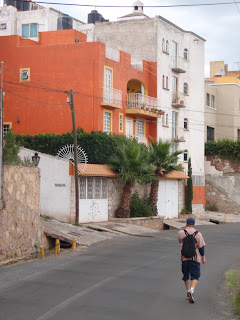
In the photo of Tom walking, the white building is our apartment building, and we're the second balcony up. What looks 
like a driveway closer to him is actually the start of the callejon we take up to the kids' school.  More on our schools next post.


Tuesday, September 2, 2008

Shifting Photos


Shift

Our week in San Diego involves shifting from bicycling trip mode to living in Mexico mode. The transition means adjusting the clothing and gear we have with us, trading bike panniers for backpacks, reviewing some basic Spanish, and adding books.

Several sources have said it is difficult to locate English language books in Mexico, so we went to secondhand bookstores to load up for 10 or 25 cents a book. (Added a few new books as well, but only one hardback - The Magician, sequel to The Alchemist, which everyone read on the bike trip.) How many books will the four of us, typically pretty voracious readers, want to read while in Mexico? Heading into a completely new adventure, that is yet another aspect we cannot exactly predict.

With my sister, we have visited the San Diego zoo, the community pool that has a huge water slides, the beach for another round of boogie boarding, the horse lady in the neighborhood so Dana and cousin Alexi could ride, and the three cousins have had plenty of play time. Meanwhile we're packing up the tandems to send home by Greyhound bus, cleaning and sorting the camping gear, wrapping up details (checking on the boy we hired to mow our lawn at home, purchasing shuttle tickets to get us to the Tijuana airport), and deciding where we will pack all those books.

While it is bittersweet to let go of the bicycling, we're excited to shift to Mexico. And if you have a teen or want a little young adult literature, I'd recommend my friend Jennifer Bradbury's novel SHIFT, a well-told tale of two boys who bicycle across the United States after they graduate from high school and a mystery when one of them doesn't return.

We fly south Sep 4, and will return to the States in January with stories to tell and (I hope!) conversational Spanish. Once I've navigated an internet connection in Guanajuato, I'll be able to report on settling in there.  Meanwhile, we wish everyone well with their September transitions as back-to-school, work, and weather changes shift us all.